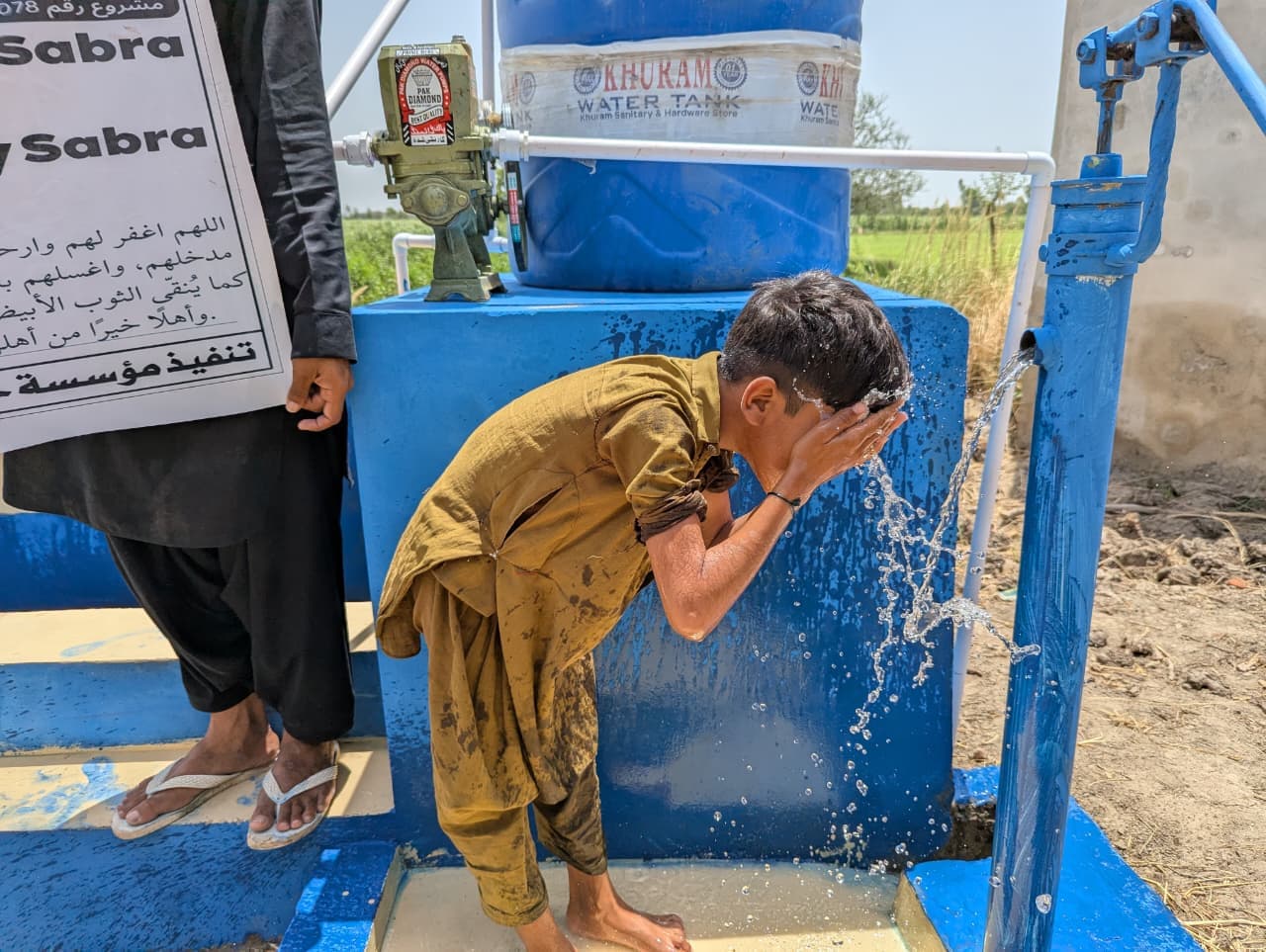

Eid Sacrifice: How does your sacrifice reach those who deserve it?
Eid sacrifice It reaches those who deserve it when it is slaughtered in an area that is truly in need, and its meat is distributed to its people at the same moment of slaughter, and you receive proof of that. This, in short, is what happens to your sacrifice with Hayat.
Every year a Muslim pays the price of his sacrifice and has a question in his heart that he does not always say: Who will eat it? Does it go to someone who really needs it, or to someone who has enough? Can I be sure?
This article does not talk about the price or the reservation method, but rather about the other party: the family that receives the meat. And who Digging wells and watering water: ongoing charity in your name As for the Eid sacrifices, the question remains for Hayat one: Did the impact reach those who deserve it?
Article summary:-
This article answers one question from five angles: To whom does the Eid sacrifice go? We start with who deserves it in the Qur’an and Sunnah, then how the place of slaughter is chosen, how the families who receive it are determined on the day of slaughter, why are the sacrifices distributed at the same moment during the days of Eid, and finally what is the impact of your sacrifice in numbers?
The most important facts: The Qur’an gave the poor person a share of the sacrifice. Lives are carried out in areas of greatest need, and sacrifices are often carried out in African countries, where more than 20% of the population suffers from hunger (307 million people in 2024). The people of neighboring villages are informed before slaughtering, and the meat is distributed immediately after cutting. Sheep reach 12 families, goats reach 8, and large cows reach 60, and you receive the distribution video with a sign bearing your name.
1. Who is worthy of the Eid sacrifice according to the Qur’an and Sunnah?
A fixed share for the needy
The sacrifice is not a sacrifice that can be eaten by its owner alone. In the Qur’an: “Eat from it and feed the needy and needy” (Surat Al-Hajj, 28). And in another verse: “Eat from it and feed the contented and the freed” (Surat Al-Hajj, 36).
The two verses mention eating, then they mention feeding directly, and they name the one who is fed: the wretched and the poor, the contented and the poor. That is, the needy has a right mentioned by name in every sacrifice.
When the Prophet, peace and blessings be upon him, directed sacrifices to the needy
In one of the years, the Prophet, peace and blessings of God be upon him, forbade people from storing sacrificial meat, then he explained the reason after that, saying: “I only forbade you for the sake of the heater that was warmed, so eat, save, and give in charity” (Sahih Muslim, 1971). Al-Dafah is a group of needy people who came to Medina, and the Prophet, peace and blessings be upon him, wanted all the sacrificial meat to reach them that year.
Is it permissible to give the sacrifice to a non-Muslim?
Sheikh Ibn Baz was asked: “Is it permissible to give sacrificial meat to a non-Muslim?” He said: “There is no harm,” and he cited as evidence the Almighty’s saying: “God does not forbid you from those who do not fight you on account of religion.”Fatwa of Ibn Baz, 16905).
If your sacrifice is slaughtered far away: will any of it reach you?
When the Eid sacrifice is slaughtered in another country, all of its meat is distributed to the families there, and none of it is sent to you. This is permissible, as there is nothing wrong with giving the entire sacrifice in charity, as stated in the guide to the project of sacrifice. Whoever wants to combine eating from his sacrifice with feeding the needy who is far away, he should sacrifice one in his home, and make the other where the need is greatest.
So who deserves the sacrifice is clear: the needy first. But where is the needy today? How do you choose the life of the place where your sacrifice is slaughtered?
2. Where are Eid sacrifices slaughtered? Choose the area before choosing the family
Base: the most in need
Hayat says about her projects: “We implement in areas of greatest need, and you can specify the preferred country when completing the request.” The first step in making your sacrifice reach those who deserve it is the place itself: the area of need is predominant, without exception.
Why mostly Africa?
Live sacrifices are mostly carried out in African countries from the list of implementation countries, such as Tanzania, Chad, Uganda, Malawi, Niger and Kenya. The reason is explained by the numbers: according to United Nations hunger report 2025 The percentage of people suffering from hunger in Africa has exceeded 20% of the population in 2024, that is 307 million people. In homes like these, a piece of meat on Eid is not a custom, but rather an event.
Why is close distribution not enough?
In many cities, a needy family receives more than one bag of meat for Eid from neighbors and relatives. As for a poor village far away, not a single sacrifice may reach it. It is the same sheep in both places, but its effect on the family that receives it is not the same.
You choose the country
If you have a connection to a specific implementing country, specify it upon request. If you leave the matter to life, your sacrifice will be slaughtered where the need is greatest.
The area is selected. But within the same region, the more accurate question remains: Who are the people who receive the meat on the day of slaughter?
3. Who receives the meat of your sacrifice on the day of slaughter?
People of neighboring villages are informed in advance
Before slaughter The people of the surrounding villages are informed of the date so that they can attend. The beneficiaries are not names on paper, but rather families from the same area in need who come to the slaughtering site.
Slaughtering in front of people
The sacrifice is slaughtered, the name of God is mentioned over it, and it is raised Pray for its owner In his name, and the families present bear witness to this. This makes the distribution public: those who attend see the sacrifice, see the meat being cut, and see who received it before them.
Why this method?
| method | What it includes |
|---|---|
| Implementation in an area in need | The families present are mostly the ones in need |
| Inform neighboring villages before slaughtering | That the news reaches the largest number of homes |
| Distribution to everyone | The meat should not go secretly to people other than its owners |
| The painting is with your name in the video | To know that this is the meat of your sacrifice |
I knew who was receiving it. It remains to be known when the meat reaches them, and why timing is part of the sacrifice reaching its deserving recipients.
4. Distributing sacrifices on Eid days: Why at the same moment?
From knife to home on the same day
With life The carcass is slaughtered, cut and distributed at the same moment. There are no refrigerators, no warehouses, and no long-distance transportation. The meat comes from the place of slaughter in the hands of the family, and is cooked in their home on the same day.
What does this mean for the family?
- Fresh meat: It arrives as is, without storage the family may not have the means.
- Joy on her day: The family eats on Eid days, not after them.
- No intermediaries: The hand that receives is the hand of the present person in need.
What about the time and conditions of slaughter?
The correct time for slaughtering the sacrifice, the conditions for the sacrifice, and the method of reservation are all explained in detail in the guide Sacrifice project. Here it is enough for you to know that your sacrifice is not considered a sacrifice except at its time, and that the distribution with Hayat takes place immediately after the slaughter.
The meat arrived to the family on that day. But how many families exactly? What difference does your sacrifice make in numbers?
5. The impact of the Eid sacrifice in numbers: How many families is the sacrifice sufficient for?
Number of families per carcass
| The carcass | The number of families whose meat reaches it is approx |
|---|---|
| Goat | 8 families |
| Lamb | 12 families |
| Big cow | 60 families |
If your whole family sacrifices
In many families more than one person sacrifices. Imagine the impact:
- 3 sheep From a father and two sons: about 36 families You eat meat at Eid.
- 5 sheep Of brothers, each of whom sacrifices for his home: like 60 families.
- One big cow: towards 60 families All at once.
You can find all types of Eid sacrifices on... Sacrifice page.
The effect you see with your own eyes
The impact does not stop at a number in a table. You will receive after implementation:
- Pictures From the day of slaughter.
- Slaughter video And there is a plaque with your name on it.
- Distribution video It has a plaque with your name on it, and the families receive the meat.
The distribution video in particular is the direct answer to the article’s question: You see with your own eyes the hands that received your sacrifice.
Frequently asked questions about the Eid sacrifice
Who deserves the sacrifice? The needy first, according to the Almighty’s saying: “And feed the needy and the needy.” It is permissible for its owner to eat from it and give it as a gift.
Is it permissible to give the sacrifice to a non-Muslim? Yes, Sheikh Ibn Baz said: “There is no harm” as long as he does not fight the Muslims.
How do the beneficiary families choose their lives? It is carried out in areas of greatest need, and the people of neighboring villages are informed of the slaughter time so that they can come, and then the meat is distributed to them in front of everyone.
Where are Eid sacrifices slaughtered? Mostly in African countries of implementation, and you can choose the preferred country when ordering.
When are the sacrifices distributed? At the same moment of slaughter, the meat arrives fresh to families on Eid days.
How many families does the sacrifice suffice for? Goats about 8 families, sheep about 12, and large cows about 60.
How do I make sure that my sacrifice reaches those who deserve it? You receive a video of the distribution, showing the sign with your name and the families receiving the meat.
Where can I find the price of the sacrifice and the time of its slaughter? In a guide Sacrifice projectIt includes prices, time and conditions.
Your sacrifice is worth making
Eid sacrifice Worship has two sides: you when you sacrifice to God, and the family who eats. The Qur’an did not leave the second party unknown, but rather called it: the miserable, poor person. That is why Hayat cares that your sacrifice be slaughtered in an area in need, that its people attend, that the meat be distributed to them on the days of the holiday itself, and that you see that in a video bearing your name.
Choose your sacrifice from Sacrifice page, or Ask for your sacrifice Select the country and name on the plate.
Meat on their tables, and wages on your scale.