
How to choose a reliable organization to drill a well in your name?
The well you pay for will have a name that means you, and will be in a village you won't visit often. The question that comes before everything: How do I know that this organization will actually do what I paid for?
Choice A reliable institution for drilling a well Not a feeling, but an examination. This article gives you seven criteria by which to examine any entity before paying it a single riyal, and applies them to us first, including what we do not own.
Article summary:-
This article explains how to evaluate any entity before completing your application with it: the legal entity and where to verify it, the type of proof you will receive after implementation, is the price final or subject to increase, how the project site is chosen, what the announced beneficiary numbers mean, who undertakes maintenance after delivery, and how to test communication channels before payment, not after.
The seven criteria in order: Legal entity · Documentation · Price clarity · Choose a location · The beneficiary numbers are accurate · Maintenance · Communication channels. At the end of each criterion is a specific question that you ask the entity, and the Hayat Foundation’s answer to it.
1. Legal entity: Who actually is the entity?
Start with one question
“What is your legal name, in which country are you registered, and under what number?” A reliable institution answers in one line. A destination that evades or gives you a brand name with no entity behind it, then the check is over.
Where to check yourself
The name alone is not enough. Official records are available to the public:
- In Saudi Arabia: a tool National Center for Non-Profit Sector Development Enables verification of the validity of licenses and collection channels.
- In Britain: Official register in England and Wales Allows searching by name, number or activity.
- In the United States: IRS tool Reveal the status of tax-exempt organizations.
We say about ourselves what needs to be said
Hayat Foundation is not a charity. We are an enforcer registered in the state of Wyoming, United States, and our incorporation documents are published in About us page. The client purchases the implementation of a specific project at a stated price and receives proof of it.
This difference has a practical impact that you should know: you will not find us on the charities register, because we are not there. On the other hand, our price is a service price, not a fund proceeds, and the proof is linked to your project, not to a public report.
This may seem like a point against us, and we write it ourselves for one reason: the party that hides its legal classification from you will hide from you what is more important.
I knew who it was. What remains: What will you receive from it?
Why do we write this instead of hiding it?
Because the party that hides from you its legal classification and method of operation will hide from you what is more important. Because you have the right to know exactly what you are paying for before you pay.
I knew who it was. What remains: What will you receive from it?
2. Documentation: What proves that the project was implemented?
The difference between a promise and proof
Every party says, “We implement it honestly.” The real examination is one question: “Show me the entire documentation for a previous project, now.” The party that has the documentation opens it for you in seconds, while the party that does not have it promises you it after payment.
The minimum acceptable level for any well project
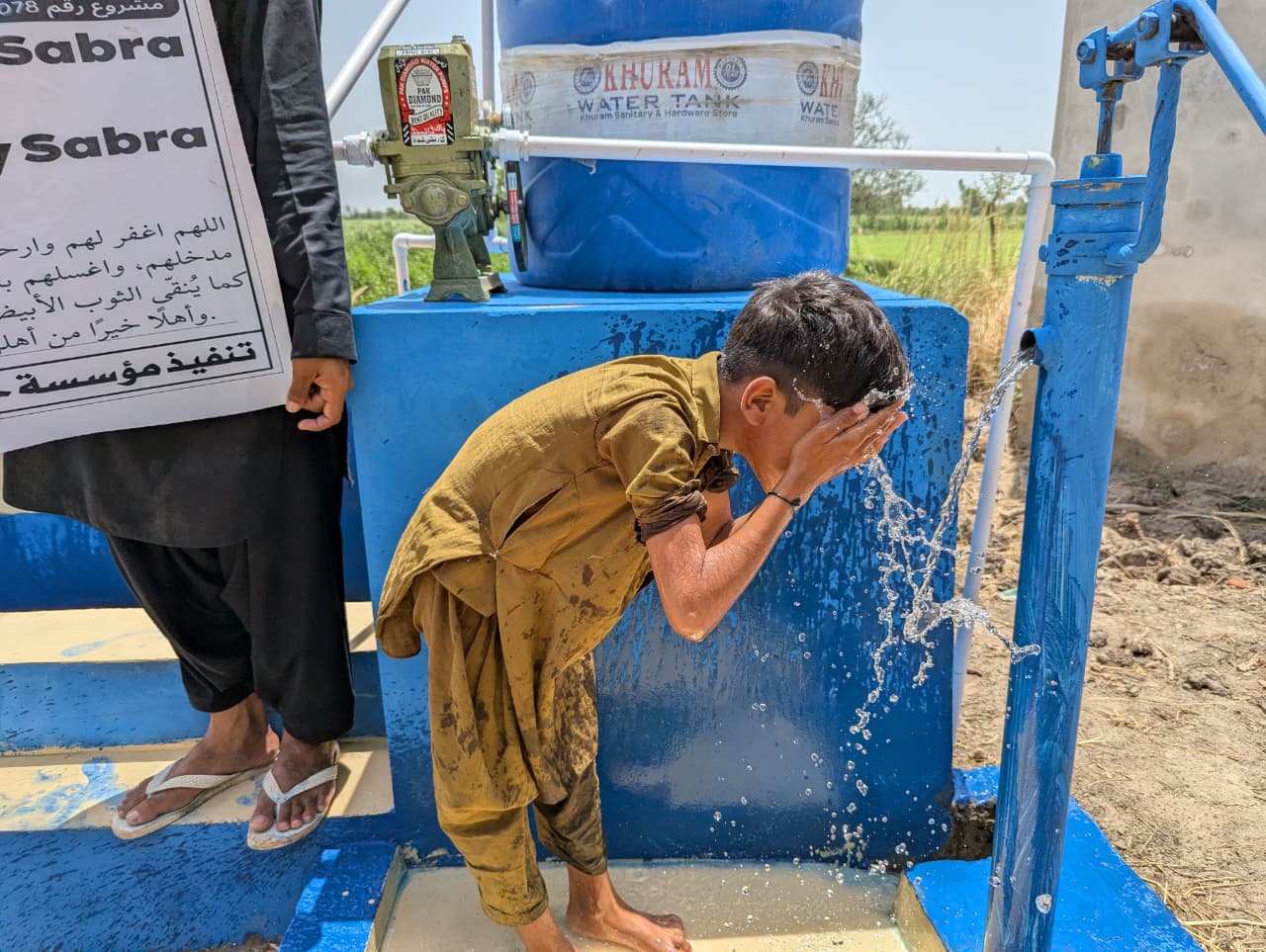
- Pictures of the site before and after implementation.
- A video of the project in action and with water flowing.
- Marble plaque bearing The name you requested, installed on the well itself.
- Geographic coordinates You open it yourself on the map.
The first three can be photographed anywhere. The fourth is the one that is difficult to fakeBecause it places the project at a specific point on Earth that anyone can open.
How to examine documentation instead of contemplating it
Open the coordinates on the map and see: Is it in a rural area similar to what is in the pictures? Compare the nameplate in the video to the name written on your application. The details of what is depicted in each stage we have are explained in How are well projects documented?, and real models published in Documentation page And in The story of a client who implemented nine wells.
⚠️ Note regarding sacrifices: Documenting the carcass, photos and clips of slaughter and distribution, No coordinatesBecause it is work done in one day, not a fixed facility. Any entity that promises you coordinates for a sacrifice is selling you something meaningless.
Documentation proves implementation. So what is the number you will pay?
3. Price: Is it final or the beginning of negotiation?
Three marks on a sound price
- Advertised on the page Before you ask, it's not sent in a private message.
- Related to specifications: Depth, pump type, components, number of days of implementation.
- Final, without “administrative fees” or “cost differences” that appear after payment.
A different price is not necessarily a bad price
A $240 well and an $899 well are neither a scam nor a competition, but two different products: different depth, different pump, different energy. Complete differences in The cost of drilling a wellPages for the three types are published with their specifications: Surface well with hand pump AndMedium artesian well AndDeep artesian wellAnd the prices of carcasses in Sacrifice prices.
The correct question is not “Why is your price higher?” Rather, “What exactly does your price include?”
The payment method is part of the examination
A serious entity that receives payment through institutional channels that have a written effect, not through a personal transfer to an account in the name of an individual. Our channels are explained in Payment methods.
The price is clear. But where will the project be implemented?
4. Location and beneficiaries: The number that reveals the entity
Who chooses the place?
Ask: “Should I choose the country? Who chooses the village within it? And how? The honest answer is that the client chooses the country, and the location within it is determined by two paths: reports submitted by the field team, or a request received from the people of a village where there is no water source, and then the location is evaluated before implementation. Our pages for each country are open: Pakistan AndIndia AndNepal AndBangladesh.
The more precise test: What does the beneficiary number mean?
Here the sides are revealed. When you read, “This well serves 250 people,” ask: Is this an actual list of names, or an estimated capacity of the project?
In all Our monthly reports We write the same sentence: “Beneficiary numbers represent the estimated capacity of the projects, and are not a unique count of people.” A living example in May 2026 report.
Why is this sentence important to you?
Because the party that announces huge numbers without this reservation either does not know how it calculated them, or knows and does not want you to know. The honest number is always smaller than the gross number.
It remains the standard that most people forget.
5. Post-delivery: maintenance and communication channels
A well is not a product that is delivered and finished
Pumps break down, parts wear out, and the project may stop after months. Ask before paying: “Who will fix it if it breaks down after a year? Is that included in the price? Common malfunctions and how to deal with them are explained in Well maintenance.
Test communication before you pay
The simplest and cheapest inspection: send a detailed question via Contact page See when you receive a response, and whether it is a response to your question or a prepared message. The party that ignores you before paying will not be better after it.
Five warning signs to stop immediately
- Urgency for speed: “The opportunity ends today” is a sales method, not a legitimate method. A project that takes weeks to implement does not require a decision in minutes.
- An account in a person's name Instead of an institutional payment channel that has a receipt.
- Pictures without context: Beautiful pictures of wells without a project number, date, or location, suitable for any destination and any year.
- Reject a previous documentation offer Under the pretext of privacy. The names of the clients are hidden, but there is no objection to displaying a complete project file without a name.
- Absence of address and entity: A website without an “About Us” page containing a legal entity, or contact numbers that no one answers.
Having one mark does not necessarily mean fraud, but it does mean that you ask for a written explanation before you continue.
The list is in seven lines
- Legal name, country of registration and number.
- Previous project documentation file, displayed before payment.
- Coordinates you open yourself (for wells).
- Announced and final price linked to specifications.
- Clarity of who chooses the site and how.
- Beneficiary numbers are accurately described, not inflated.
- A written answer about maintenance after delivery.
Frequently asked questions
What is the first thing I check in a reliable well drilling organization? Legal entity: name, country of registration and number, then check it in the official registry of that country yourself.
Does every entity that implements water projects operate on the same model? no. Some operate on a non-profit model, and some are registered entities that offer implementation at a published price. Life Foundation of the second type: An institution of a humanitarian nature with a declared business model, and registration details in About us page.
How can I be sure that the well was executed in the location I was told? With geographical coordinates that you open on the map, with photos and video, as in Documentation guide.
Why do prices differ between destinations? Because the product itself is different: the depth, the pump, the ingredients, and the number of days of implementation. Compare specifications not numbers, details in The cost of drilling a well.
Can I choose the country? Yes, the country is chosen by the customer when completing the order. The location within it is determined by a field report or at the request of the village people, then an evaluation.
What is the difference between the number of beneficiaries and the capacity? Capacity is an estimate of what the project can serve daily according to its specifications, and is not a census of people's names. This is what we declare in every way Monthly report.
What if there is no safe water on the site? Drilling is repeated at another location within the same area until clean water is reached.
Is the documentation the same for sacrifices? no. The carcass is documented with pictures and clips of slaughter and distribution, along with a name plate, without coordinates, because it is work in one day and not a fixed facility.
What is the easiest test before paying? Send a detailed question and wait for a response. The speed and accuracy of the response is an early indicator of what you will receive after paying.
Check us out before you get started
Don't believe this article. He applied his seven criteria to us: Read Registration documentsAnd open Documentation filesAnd review Monthly figuresAnd read Client story From beginning to end.
If you are convinced, choose your project from Well projects Or Sacrifice page, or Ask us First.
An organization that is afraid of your questions does not deserve to bear your name.