
The difference between a surface well and an artesian well: which one to choose?
The difference between a surface well and an artesian well It starts from the depth: the shallow well with a hand pump is drilled to about 20 meters and serves more than 20 people per day, and the artesian well is drilled to 60 meters in the medium type and 80 meters in the deep type, reaching a further water layer and serving more than 80 or more than 250 people per day. From depth, the rest of the differences branch out: the pump, the above-ground equipment, the lifespan, and the place to which each type is suitable.
Many customers stop at this question before completing the order, so they open the pages of the three projects one after the other to compare for themselves. This page puts the entire comparison in one place.
Article summary:-
This article explains The difference between a surface well and an artesian well From five angles: what does each name mean, from which layer does each well take its water, what is built above the ground in each type, then when is a surface well enough for you and when is artesian worth its difference, and finally how do you make your choice with three questions.
The most important numbers: depth is 20 meters for shallow, 60 meters for medium artesian, and 80 meters for deep artesian. The life span is about 10 years, then 15 to 20 years, then more than 50 years. Implementation period is 7 to 10 days for superficial and medium, and 10 to 15 days for deep. The three types are implemented in Pakistan, India, Nepal, Bangladesh and other implementing countries, and they come with a marble plaque with your name, video documentation, coordinates, and maintenance every 6 months.
1. The difference between a surface well and an artesian well in one table
Definition in a sentence for each type
- Surface well with hand pump: A shallow well that reaches water near the surface of the earth, and water is drawn from it using a hand pump.
- Artesian well: A well drilled to a much greater depth to reach a more distant aquifer, and prepared to suit the size of above-ground use.
Comparison by standard
| Standard | Surface with hand pump | Medium artesian | Deep artesian |
|---|---|---|---|
| Depth | 20 metres | 60 metres | 80 metres |
| Beneficiaries daily | More than 20 people | More than 80 people | More than 250 people |
| Shelf life | About 10 years | From 15 to 20 years | More than 50 years |
| Duration of implementation | 7 to 10 days | 7 to 10 days | 10 to 15 days |
| Maintenance follow-up points | 2 | 5 | 7 |
Where is the price?
Prices start at $240 for shallow and go up to $899 for deep, and the full schedule with what's included in the price is in The cost of drilling a well. We kept it there so this page remains for technical comparison alone.
The table gives you the numbers. But why does everything change with depth? The answer is underground.
2. Where does each well get its water from?
What is an artesian well originally?
The word “artesian” in its scientific origin describes a well that reaches a layer of water sandwiched between two solid layers, so the water in it is under pressure. And get acquainted US Geological Survey Wells that reach these confined layers are called “artesian wells,” and remember that pressure in some cases pushes water to the surface of the earth without the need for a pump.
In daily use, the name “artesian well” came to be applied to a deep well dug with equipment, to distinguish it from a shallow well. This is why you find pumps and equipment in our artesian wells, because the water does not rise alone in every location.
Surface well: close-in water and simple equipment
The surface well draws from water near the surface, so a depth of 20 meters and a hand pump that the user drives himself is sufficient. This simplicity is what makes it quicker to start and less to prepare.
Artesian well: further layer and longer duration
The deeper the drilling descends into a water layer, the greater the distance between the well and the surface fluctuations. And she points US Geological Survey Until the groundwater level drops too much, the owner of the well may have to deepen it or dig a new well, and withdrawing faster than compensation may dry up the wells, especially in periods of drought. This explains part of the correlation of depth with lifespan in our table: 20 meters versus about 10 years, and 80 meters versus more than 50 years.
What if there is no safe water at the expected depth?
Re-drilling elsewhere within the same area Until access to clean water, this applies to all three species.
I knew what was underground. What is built on top of it in each type?
3. What is built above the ground in each type?
Each type has its follow-up points
The clearest thing that reveals the difference above ground is the list of points that our team follows up on during maintenance visits for each type:
- Surface well with hand pump: The pump, and the well floor.
- Medium artesian well: The above, along with the faucets, the connecting pipes to the tank, and the tank itself.
- Deep artesian well: The above, along with the body of the well, and the ablution seats.
That is, the artesian well is not only a deeper hole, but a larger facility: a tank that collects water, faucets from which more than one person takes it at the same time, and in the deep place there are seats for ablution because it is usually carried out next to a mosque or school. And details of the possible malfunctions and the treatment of each of them in Well maintenance.
A real example of documented wells
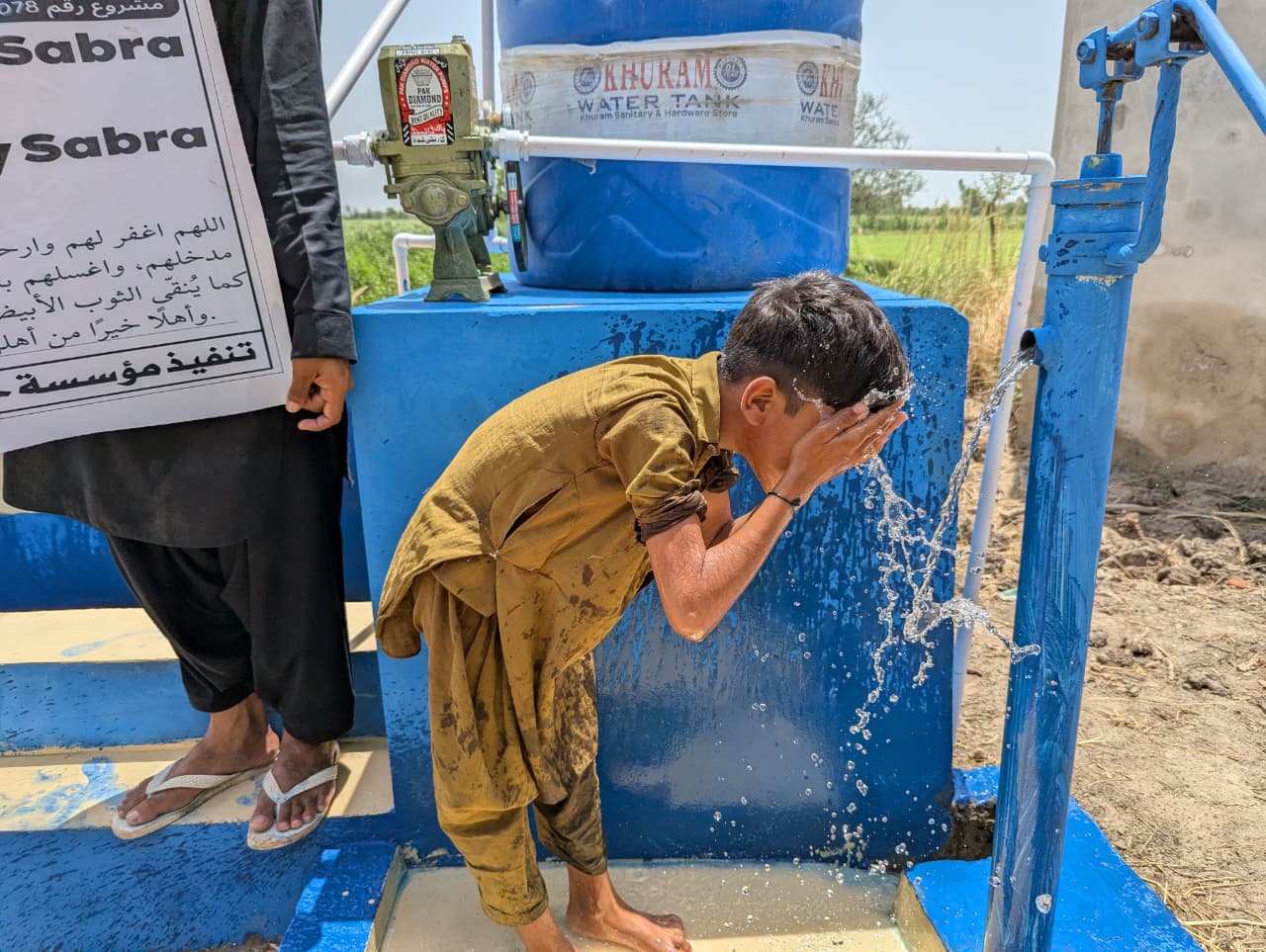
Project No. 1109 In the Ghotki region of Pakistan: a medium artesian well with a depth of 60 meters, implemented in May 2026, and operated by a pump Electric and manual together. Pictures of the project before and after painting are published, and similar ones will be sent to you about your well, and other examples in Documentation page.
What do the three types have in common?
The implementation stages themselves, the marble plaque installed in cement with your name, the final video with a link to the location on the map, and maintenance every 6 months are included in the price. The full list of what's coming to you Documentation of well projects.
The picture became clearer. The practical question remains: which one is right for you?
4. Surface or artesian well? When is each type sufficient?
When is a surface well enough for you?
- If you want to start now on a limited budget: It is the least expensive type, and the reward for watering water is not measured by the number of meters.
- If you want more than one well: The lower price allows the implementation of several wells in the names of several people, and one of our clients has implemented nine wells in the names of his parents and members of his family, as in His whole story.
- If your goal is a small pool: More than 20 people a day means entire households no longer travel distances in search of water.
This is actually the most popular choice: in the September 2026 Achievements Report it was 125 wells out of 178 Manual surface wells, and the reports are all published in Monthly reports.
When is the average artesian well worth its difference?
- If you want a clearly larger effect than the surface: More than 80 people per day instead of more than 20.
- If lifespan is a priority for you: From 15 to 20 years instead of about 10 years.
- If you want a tank and faucets: People take water without waiting for a single pump.
When is a deep artesian well the decision?
- If you want the longest possible life: More than 50 years, meaning that the well may serve two generations.
- If you want the well to be connected to a mosque or school: It has benches and ablutions and serves more than 250 people daily.
- If the well is an ongoing charity on behalf of someone you love and you want it to be extended: Longer life means that water runs through its name for more years, and details in An ongoing charity for the deceased and the parents.
What does not determine your choice?
State. The price and specifications are based on the depth, the number of beneficiaries, and the shelf life. The country is chosen when completing the order, and the team determines the location within it.
It remains to be decided. Three questions are enough.
5. Make your choice after knowing the difference between a surface well and an artesian well
Three questions in order
- What is your budget now? If it is less than $499, then the surface well is your option, and it is a complete charity.
- How many years do you want the well to operate? About 10 years, 15 to 20, or more than 50? This is the factor to which the organization linked the higher cost: the longer the required lifespan, the more expensive it is to implement.
- Who do you want to drink from? A small community, a medium village, a mosque or a school where hundreds of people pass every day?
Short rule
- Surfactant: Quick start and less expensive, or several wells instead of one well.
- Medium artesian: Balance between price, impact and age.
- Deep artesian: The longest lifespan, the largest number of beneficiaries, and a connection to a mosque or school.
Even if I remain hesitant
Send us your budget and purpose of the well via Contact pageWe send you pictures of permeable wells of the type that suits you before you decide. You will find each country's page, such as: Pakistan AndIndia AndNepal AndBangladesh.
Frequently asked questions about the difference between a surface well and an artesian well
What is the difference between a surface well and an artesian well in short? The surface area is 20 meters deep and has a hand pump and has served more than 20 people daily for about 10 years. The artesian is 60 or 80 meters deep, with a tank and taps, and serves more than 80 or more than 250 people daily for 15 to 20 years or more than 50 years.
What is an artesian well? In scientific origin, it is a well that reaches a confined water layer under pressure, and in daily use it is a deep well drilled with equipment, as distinct from a surface well.
Shallow or artesian well: which is better for ongoing charity? Both are ongoing charity. The difference is in the number of beneficiaries and how long the well will operate, and the choice depends on your budget and the lifespan you want for the well.
Does an artesian well need a pump? In our wells, yes. Project 1109, for example, a medium artesian well in Pakistan, operates with both an electric and manual pump.
Why does a deep well live longer than a shallow one? One of the reasons for this is that it takes from a deeper aquifer, so it is less affected by the decrease in groundwater levels. The shelf life is more than 50 years, compared to about 10 years for surfactants.
Does the implementation period differ between the two types? Shallow and medium artesian from 7 to 10 days, and deep artesian from 10 to 15 days.
Is documentation different between a surface well and an artesian well? no. All types receive a marble plaque with your name, a final video of the implementation stages, a link to the site on the map, and maintenance every 6 months.
Can I choose the well type and country together? Yes. You choose the type and country when completing the order, such as Pakistan, India, Nepal, or Bangladesh, and the team determines the location within the country.
What is the price of a surface well and an artesian well? From $240 for superficial to $899 for deep artesian, full detail at The cost of drilling a well.
Choose the depth that suits your intention
The difference between a surface well and an artesian well It is not a difference in wages, but in extent: how many people drink, and how many years the well stays in operation. The superficial one has a short start, the medium one is a balance, and the deep one has an impact that extends for decades.
Browse the three types in Well projects, or start directly from Surface well with hand pump, or Medium artesian well, or Deep artesian well. To see the full picture: Digging wells and watering water: ongoing charity in your name. If you have a question before making the decision, Contact us.
The depth you choose, the pay extends.